
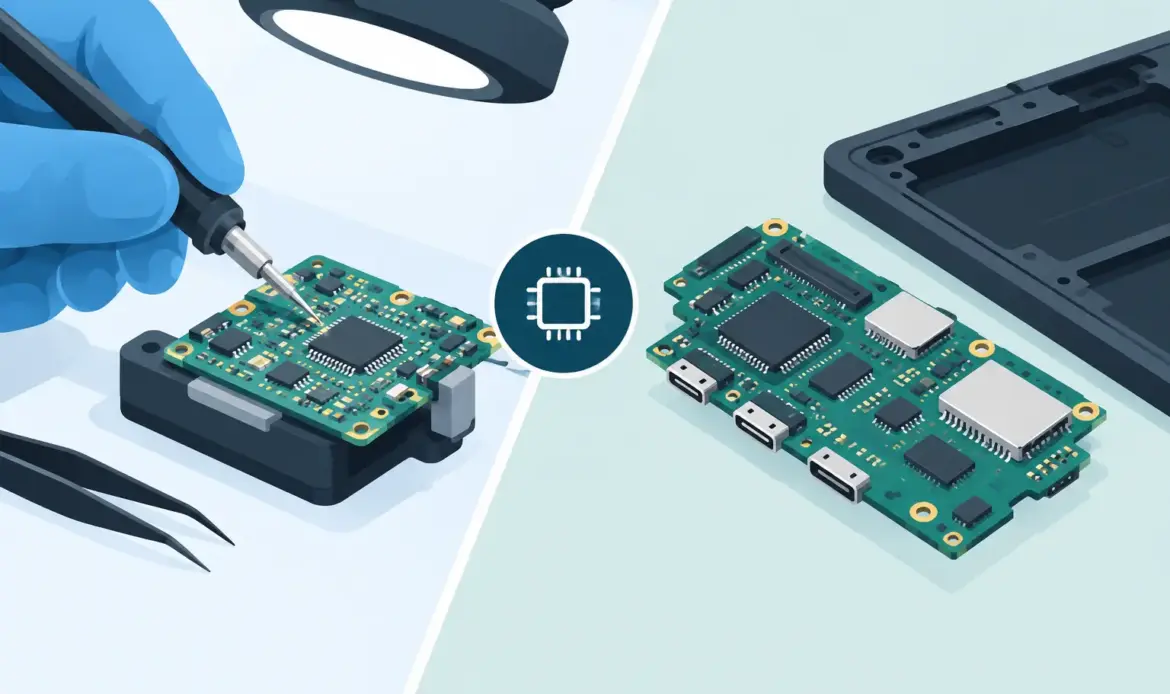
A phone that will not charge, a laptop that will not power on, or a game console that suddenly goes dark can feel like a full-blown tech emergency. The question is not always whether it can be fixed. Often, the real decision is micro soldering versus board replacement – and the right answer can affect your repair cost, turnaround time, stored data, and the long-term life of your device.
At Phone-Medics, we treat every device like it has something worth saving, because it usually does. Your photos, schoolwork, work files, game saves, contacts, and day-to-day routines may all be tied to that one piece of technology. A proper diagnosis helps determine whether a precise component-level repair can bring it back to life or whether replacing the entire board is the safer move.
What Micro Soldering Actually Repairs
Micro soldering is advanced repair work performed directly on a device’s circuit board. Rather than swapping a large assembly, a technician uses magnification, heat-controlled equipment, and specialized tools to repair or replace a tiny failed component.
Those components may include charging ports, connectors, power-management chips, audio circuits, display connectors, filters, capacitors, resistors, or damaged solder joints. They are extremely small, which is why this job requires more than a basic repair kit and a steady hand. One misplaced connection or too much heat can damage nearby components and turn a repairable issue into a much larger problem.
Think of the board as your device’s nervous system. If one tiny part fails, the entire device may stop behaving normally. Micro soldering allows a certified technician to isolate that failure and address it without automatically replacing everything around it.
Problems That May Need Component-Level Repair
A cracked screen or weak battery is usually straightforward. But certain symptoms point deeper into the device, especially when a new battery, charging cable, or screen does not solve the problem.
Micro soldering may be the right rescue when a device has intermittent charging, no power, a damaged charging port, missing audio, touch issues after a hard drop, liquid exposure, or a broken connector on the logic board. It can also help after an unsuccessful repair elsewhere, such as when a connector has been torn from the board or a solder pad has lifted.
Water damage is a common example. Moisture can corrode one small area of a board while leaving much of the device intact. Replacing the board may restore basic operation, but targeted repair may save the original board and, in some cases, preserve the data stored on it.
When Board Replacement Makes More Sense
Board replacement means removing the damaged main board and installing a replacement board. For some devices and failures, that is the most practical path forward. If a board has widespread corrosion, severe physical damage, multiple failed circuits, or damage that makes a reliable micro soldering repair unlikely, replacement can offer a cleaner solution.
It may also make financial sense when the replacement board is readily available and the device does not contain data that must be recovered from the original board. Some older or lower-value devices reach a point where the labor required for component-level diagnosis and repair costs more than a replacement board or even a newer device.
That said, board replacement is not always a simple shortcut. The board is often tied to important device functions. On many phones, tablets, and computers, the original board holds the storage, security information, and identifiers that make the device uniquely yours. Installing another board can mean losing locally stored photos, messages, files, app data, and game progress if those items were not backed up.
A replacement board can also introduce compatibility concerns. Parts such as cameras, biometric features, displays, and wireless components may need to be properly matched, calibrated, or tested. A quality repair is not just about getting a device to turn on. It is about making sure it works the way you need it to work afterward.
Micro Soldering Versus Board Replacement: The Real Trade-Offs
The best option depends on the failure, the device model, your budget, and what is on the line if the original board cannot be saved. There is no honest one-size-fits-all answer.
Micro soldering is often the stronger choice when the damage is isolated. Repairing one failed charging circuit or connector may cost less than replacing a full board, especially on a newer device. It can also preserve your original storage and settings, which matters greatly when a phone will not boot and the data was never backed up.
Board replacement can be the better choice when damage has spread across the board or when a repaired board would carry too much uncertainty. If corrosion has affected multiple layers and circuits, a technician may be able to fix one visible issue only to have another failure appear later. In that situation, a replacement board may offer more dependable results.
Turnaround time can vary too. A board replacement may be fast if the correct part is available. Micro soldering requires careful diagnosis before any repair begins, because the visible symptom is not always the true source of the problem. A device that will not charge, for example, may have a bad port, a failed charging chip, battery damage, corrosion, or a problem with the charging cable itself.
The goal is not to choose the fastest-looking repair. It is to choose the repair that gives your device the best chance of a reliable return to service.
Why Diagnosis Comes Before the Repair Plan
No responsible technician should promise a board replacement or micro soldering repair based only on a quick description at the counter. Good diagnosis protects you from paying for the wrong fix.
A thorough evaluation starts with the symptoms: What happened before the failure? Was there a drop, a spill, overheating, a charging issue, or a recent screen repair? From there, technicians inspect the device, test power behavior, check charging response, look for liquid indicators or corrosion, and examine connectors and board-level components when needed.
This process matters because similar symptoms can have very different causes. A phone that is stuck on a black screen may have a failed display, a dead battery, a damaged display connector, or a board issue. Replacing the board before checking the display path could waste time and money. Replacing a screen when the board is the actual problem does not rescue the device either.
At Phone-Medics, the repair recommendation should be based on what the device needs, not on whichever repair is easiest to sell. Sometimes that means a targeted micro soldering repair. Sometimes it means a replacement board. Sometimes the most customer-protective answer is that the repair is not cost-effective, and you deserve to know that before moving forward.
Data Can Change the Decision
For many people, the device itself is replaceable. The information inside it is not. That distinction is especially important when deciding between board repair and board replacement.
If your phone contains irreplaceable family photos, your laptop has business documents, or your console holds years of game saves, preserving the original board may be the priority. Micro soldering can sometimes restore enough function to retrieve data even when the device is not worth keeping long term.
There are limits. Severe liquid damage, burned board layers, or damaged storage components can make recovery impossible. Still, it is worth mentioning your data concerns before any repair begins. That lets the technician approach the job with the right goal: full restoration, temporary boot for data recovery, or the most economical reliable repair.
Do Not Let a Small Failure Become a Bigger One
Repeatedly forcing a loose charger into a port, using damaged cables, powering on a wet device, or trusting a bargain repair attempt can turn a small board problem into a major one. If charging feels loose, the device gets unusually hot, it works only at a certain angle, or it stopped working after moisture exposure, stop using it and get it checked.
Fast action is especially helpful after liquid damage. Do not plug the device in to see whether it still works. Power and moisture are a bad combination, and corrosion can keep spreading after the initial spill.
Your device does not need a guess. It needs a careful rescue plan. Whether micro soldering can save the original board or replacement is the wiser route, a precise diagnosis gives you a clear path forward – and the best chance to get your tech back where it belongs: in your hands, working when you need it.